
Storytelling ...
it's not just for children

Please consider a paid subscription today. Even the monthly dollars help me continue to write. Your support makes this work possible and is deeply appreciated.
On Saturday August 9, 2025, I hosted and curated a queer elders storytelling event for MediaRites. I introduced the other storytellers, then told my own story. Our stories were on the topic of Courage, Grit, and Grace. My story was about becoming a poet, quitting poetry for forty years, then picking it up again.
The other storytellers were an artist, a poet activist, a transman, and singer/choir director. These people are well known in our community and many of the people in our audience didn't know their backstories.
We held the event at the Q Center, which once was a hub of the community. Covid decimated it, and it is just beginning to build back up. Unfortunately, the manager who was supposed to meet us over an hour before the event started never showed up at all. No one from the Q Center was there. We were able to get inside because we had a code. But all the equipment, including the chairs, was locked up where we could not access it.
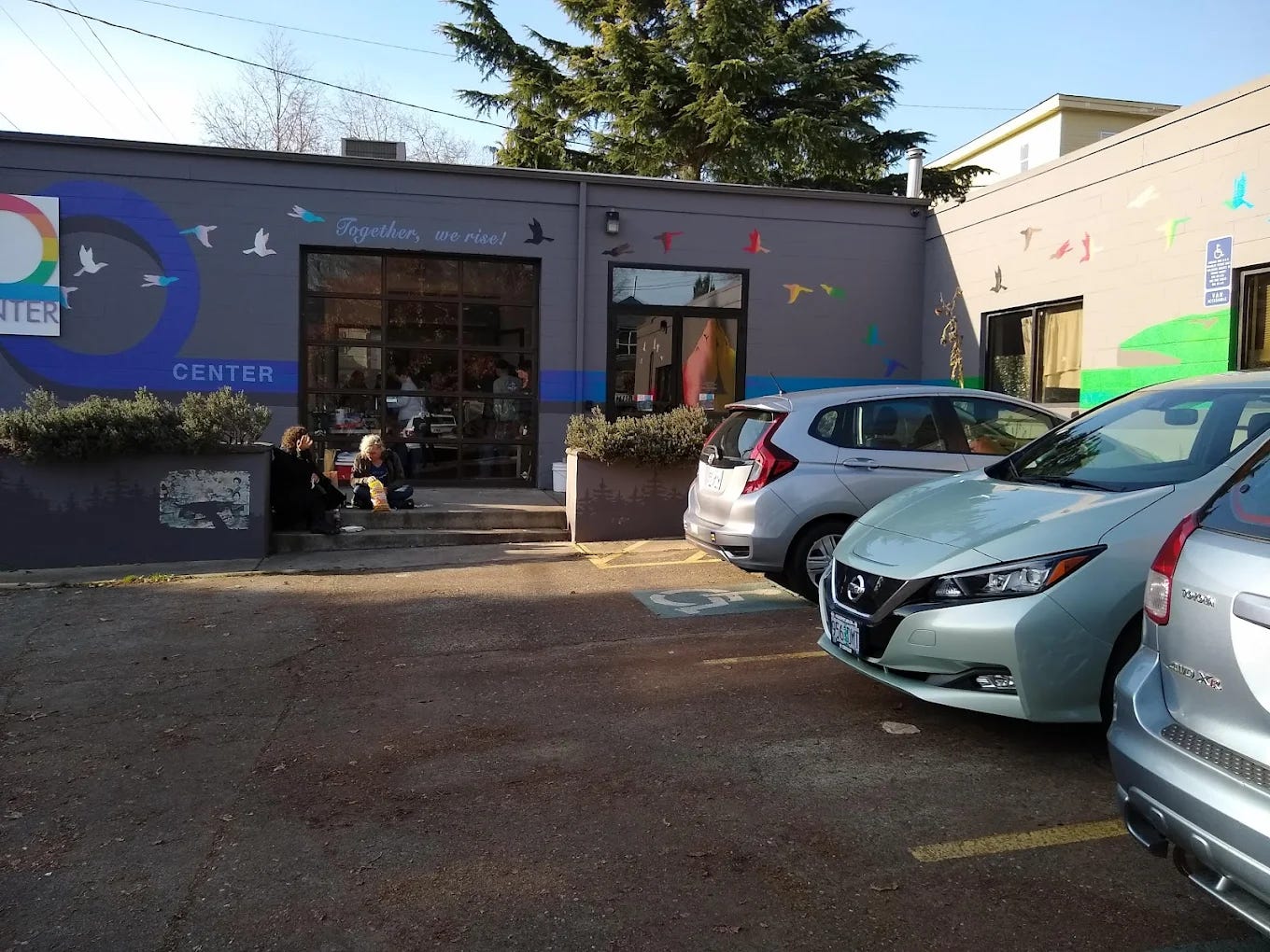
Undaunted (well, maybe a little daunted), we went without a microphone, moved tables, brought chairs out of public rooms, and set up a stage and audience seating ourselves. We needed a podium, but it was -- of course -- locked up. So I commandeered a book shelf and two enormous books from the library, and created a make-shift podium.
The day was hot, but somehow the air conditioning had been left on. So our audience was able to sit comfortably to hear our stories. The audience heard tales of personal triumph, and I saw many people moved to tears, surprise, even laughter. They applauded and cheered each speaker.
After the stories, the audience stayed on to talk with the storytellers, to talk with each other, and maybe think about their own stories.
In case you're curious, here is the story I told.
I'm a poet.
I come by it naturally.
My dad wrote poems—usually short little love poems to my mom.
I don’t know whether she wrote poems before she met him, but all my life, Mom wrote poems too. She wrote them for birthdays, anniversaries... she even wrote poems about birds. My dad taught me to read when I was four years old. The book he taught me from was a book of poetry. This book: Now We Are Six by A. A. Milne. (Hold up book)
I started writing early.
I won my first writing contest when I was twelve.
I got to read my essay to the American Legion folks, and received the grand prize: three dollars.
(pause)
Big money in 1956.
At fourteen, I wrote a poem about abortion.
It wasn’t legal then, but it was definitely on my mind.
My mom subscribed to True Story magazine, which often told sad tales of girls getting back-alley abortions.
And I’d seen plenty of girls in my school get pregnant and married—or sent off to homes for unwed mothers.
My English teacher, Mrs. Janice Wallace, submitted that poem to a teacher’s magazine...
and they published it.
That was a surprise.
(pause)
A good one.
In my twenties, I had several poems published. Won a few more contests.
Feeling proud of myself, I signed up for a creative writing class at the University of Alaska in Anchorage.
Before the semester was over, my professor, Tom Sexton, told me I’d never be a poet—
because I didn’t write like a man.
(beat)
He pointed to a woman in our class who had nine children, and said she could write like a man.
So because of his harsh words—and my own insecurity—I stopped writing poetry.
That was 1970.
(pause)
Apparently, it was Sexton’s first year teaching.
Google says he taught at until retirement.
He was much beloved.
(beat)
Except by me, of course.
Later that same year, I heard about the women’s movement—and signed right up.
(grinning)
There was no sign-up, of course... but I did ask around to find out where I could join and get my card.
I went back to college and became an ardent feminist.
I was the first woman columnist for the University of Missouri-Rolla newspaper.
It had been in existence for 104 years.
I wrote a humor column that got me death threats.
Fortunately, this was before the internet—so they couldn’t find me.
After college, I moved to Kansas City looking for feminist theatre.
There was none—
So my friend Kate Kasten and I co-founded Actor’s Sorority.
Kate said I had to write the plays, because I was the one with the good ideas.
So I did.
I wrote three plays, right off the bat.
Then Kate and I wrote The Clue in the Old Birdbath—a Nancy Drew spoof that was produced all over the country, including a six-month sold-out run in Chicago.
In 1980, I moved to Portland.
Six months after I arrived, I founded the Portland Women’s Theatre Company.
I made a lot of friends. Some of them became lifelong pals.
I kept writing plays.
In 1987, I took a writing class from Andrea Carlisle.
She said: “Writers write.”
(pause)
I took it literally.
That November, I started writing every single day.
Vacations. Holidays. Sick days.
Nothing stood in my way.
That daily practice—that grit—gave me a little more confidence in my writing ability.
So in 2010, forty years after I stopped writing poetry... I picked it back up.
I wrote thousands of poems.
Eventually, I went to a writing residency, spent a week sorting them out.
I trashed all but about 1,500 and started editing the rest.
Editing those poems meant reliving them, remembering how I bared my soul in many of them. It takes courage to listen to our instincts, to let go, to believe in the value of our work.
At the end of the residency, the leader, Lori Lake, told me she had started a publishing company for lesbian books.
She liked my work.
She said she wanted to publish eight to eleven collections of my poetry.
I literally signed up for that.
She’s since sold the company—but not before publishing six collections of my poems.
These days, I write poetry when I’m moved to.
Still write plays—about one a year.
I’m currently working on my seventieth.
I’ve written essays, theatre reviews for Just Out and ShoutOut.
And I wrote a weekly protest column for ROAR during the orange rapist’s first term in the White House.
A couple of months ago I was awarded the Alice B. Award for consistently producing well-written works about lesbians.
It took courage to keep writing through rejection and silence.
It took grit to write when no one was asking for it.
Grace?
That came later.
I resented people like Tom Sexton.
I hated the publishers who didn’t see my talent.
But with time—and maybe a little wisdom—
I stopped blaming.
I started celebrating.
My own success.
And everyone else’s, too.
I liked myself more.
Maya Angelou said:
“Do the best you can until you know better. Then when you know better, do better.”
I try.
________________________________________________________________________
What stories are you telling yourself or others these days? Have you been to a storytelling event? What was it like?
Love your story. Very impressive. At 14 I did not know the word ‘abortion’ but I did know how women and girls got pregnant and what ‘a Durex*’ was. I cannot remember any girl getting pregnant and having to leave school - what a dull lot we were in my part of London. A female country cousin was my education when it came to such things. I will try and follow your autotale of ‘courage, grit and grace’ with one of my own. Right now I have no idea as to where I might start! 🐰 NOTE.* what we called a sheath, much like the generic term for a vacuum cleaner is ‘Hoover’. You have got me thinking. A Durex was also called a ‘rubber’ or a French letter’. Durex was a brand of condom prominently displayed in barber shops and I grew up hearing barbers lean into their customer at the end of a haircut, and whisper loud enough for everyone to hear ‘Anything for the weekend Sir?’ After that what self respecting working teenager or man was going to leave without his ‘packet of three’ (yet another name!)? Something else to write about. Thanks for that.🐰
Your story is so good. Of course, I loved hearing it in your voice. I really like the writing and reading of your own stories. I wonder if the library here would like to do that. Hmmm.