
Rumstick Road

SS 147 Rumstick Road
Warning: this is LONG. Including letters from Spalding Gray and Libby Howes. But worth reading, imho.
In March 1979, my friend and collaborator Kate Kasten and I flew to NYC to meet with American Place Theatre and discuss the possibility of their producing The Clue in the Old Birdbath as part of their new Women’s Project. I brought my eleven-year old daughter along on the trip (not to the meeting).

Our play never got produced in NYC, but while we were there, we visited every single theatre company that was doing work by women. We saw Spiderwoman Theatre performing An Evening of Disgusting Songs and Pukey Images -- twice; Nikki Cole and her Tapestry Dance Theater rehearsing Clytemnestra for an upcoming Performing Arts Festival; a rehearsal in New Haven of our play by The Theatre of Light and Shadow, a women’s music festival in New Haven where I attended a song-writing workshop with June Millington; and more. We also saw some things not by women, including the actor and puppeteer Paul Zaloom, and Rumstick Road. Kate made up our schedule and we went from 6am to midnight every single day.


When we visited the American Place Theatre, we met Julia Miles, as well as Bonnie Marranca who recommended we see Rumstick Road at the Performing Garage by the Wooster Group as an example of experimental theatre.
Rumstick Road is the second play of a trilogy by Spalding Gray. Rumstick is about the suicide of Gray’s actual mother. It used taped interviews (with his father and with her doctor) as well as personal memories to investigate her death. There were three actors: Spalding Gray, Libby Howes, and Ron Vawter. Directed by Elizabeth Le Compte. As with all their work, it was videotaped (available now on DVD for $500.)
Kate and my daughter and I went to the theater. The seating consisted of risers. We climbed up near the top for our seats so we could be sure to see everything. As it turned out, this would never have been a problem because the set was designed for everyone in the audience to see everything.
There were many things to like about the show. I was especially intrigued by the way they were able to manipulate slides over the body of Libby Howes to transform how she looked. I can’t really describe it. But I found the play performance interesting for several reasons. We wanted to leave, but we did not want to have to climb down and walk across the stage to get out (which is what we’ve had had to do.)
When we got back to Kansas City, Missouri (where we lived), I immediately wrote a letter to the Wooster Group. I do not have a copy of that letter, but I do have the letters I received from Spalding Gray (two hand-written pages), then Libby Howes seven hand-written pages), and a copy of my ten page reply to Libby.
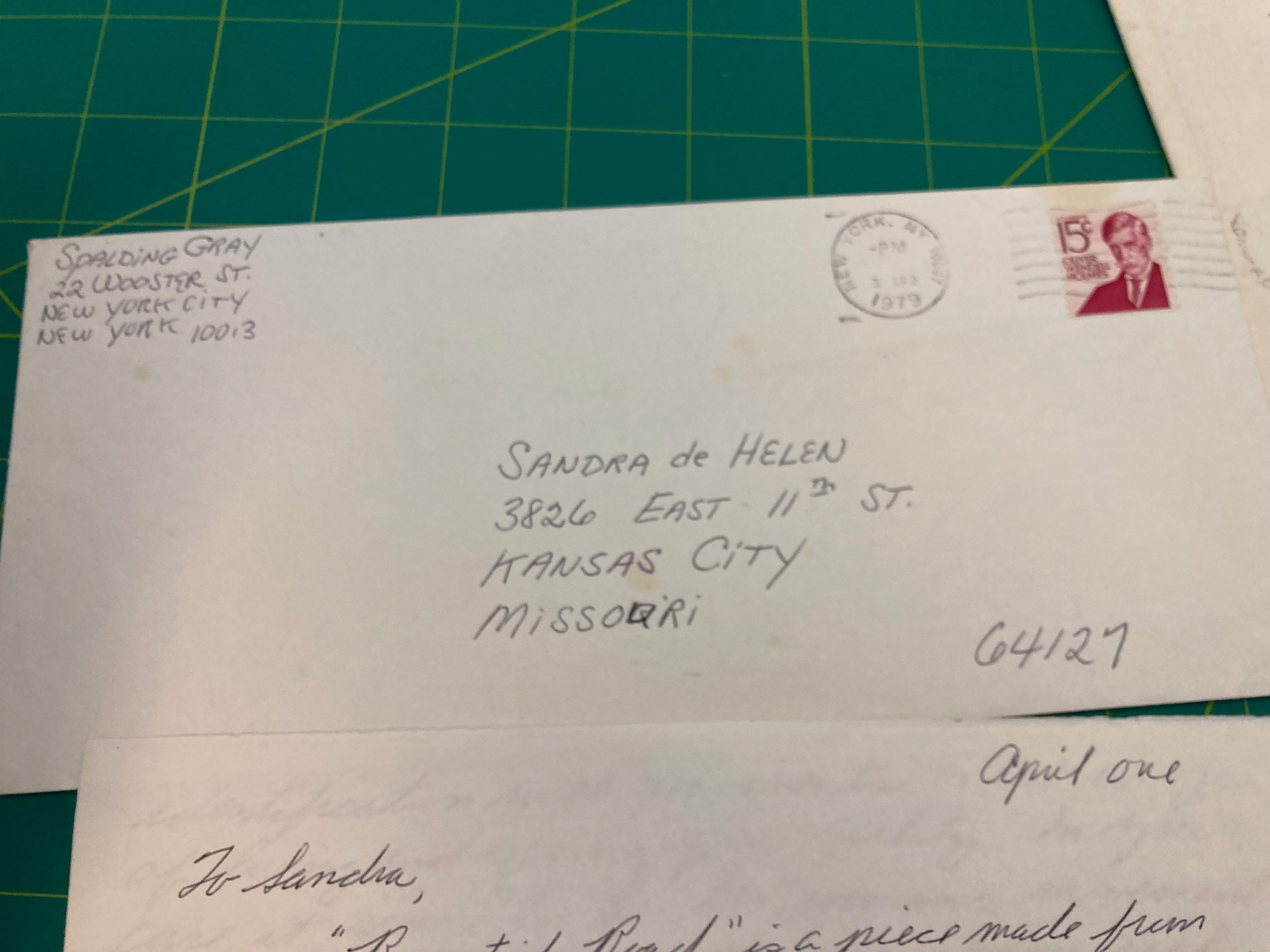
Here’s Spalding Gray’s:
To Sandra April One
“Rumstick Road” is a piece made from group improvs -- our group -- made up of men and women working together. It is directed by a woman and a large part of it is her vision and her experience with her family. The images were a reaction to some tapes, which often, but not always, delt (sic) with some members of my family remembering (a main portion of the memory tapes were my Grandmother Gray ... a very old woman and the piece is about her memory as much as anyone elses. It is also about her words, the choice of them and how she uses them) The play is not, and never was, an attempt to get inside the experience of my mothers nervous breakdown. I’m not stupid enough to ever attempt such a futile task.
“Rumstick Road” is a “play” with an open naritive (sic) form. It is open to the audience to “read in” and project on it. In your letter, you have revealed some of your projections. If you are making a mistake, and I don’t know you well enough to call it a mistake, it is that you think the “play” is only about what you saw and I’m sure it is just that for you. I also suspect that you have tunnel vission (sic), a disease that often results from a strong identification with “movements” or set ways of living and seeing your reality. In your case it seems to be the “womans movement.” It has caused a narrow vission (sic). I can tell you now that you can let go of your identification with the pain and torture of Libby Howes. She is having a good time being “licked” and “bending from the waist” (your narrow view of her dance) I do not feel that my life and my relationships are so convoluted that I do not recognize the “real” pleasure in Libby’s face and body when she does her dance or is brought to “real” laughter by Ron in that so-called “torture scene.”
I am angry with your stupidity but beyond that, the whole group is saddened and discouraged that our work could be so grossly misunderstood. It shows little hope for the most important movement -- the “brothers” and “sisters” working together!
As for your walking out. All I can say is, you should have done it. We would have stopped the show for you. We’ve done it before and we don’t see our reality as that precious. I’m sure it was good you stayed. It seems to have given you some energy (A - MORAL energy not good or bad, and some grist for your MILL.
Sincerely, Spalding Gray
[Insulting me every chance he got, and misrepresenting his play and himself.]
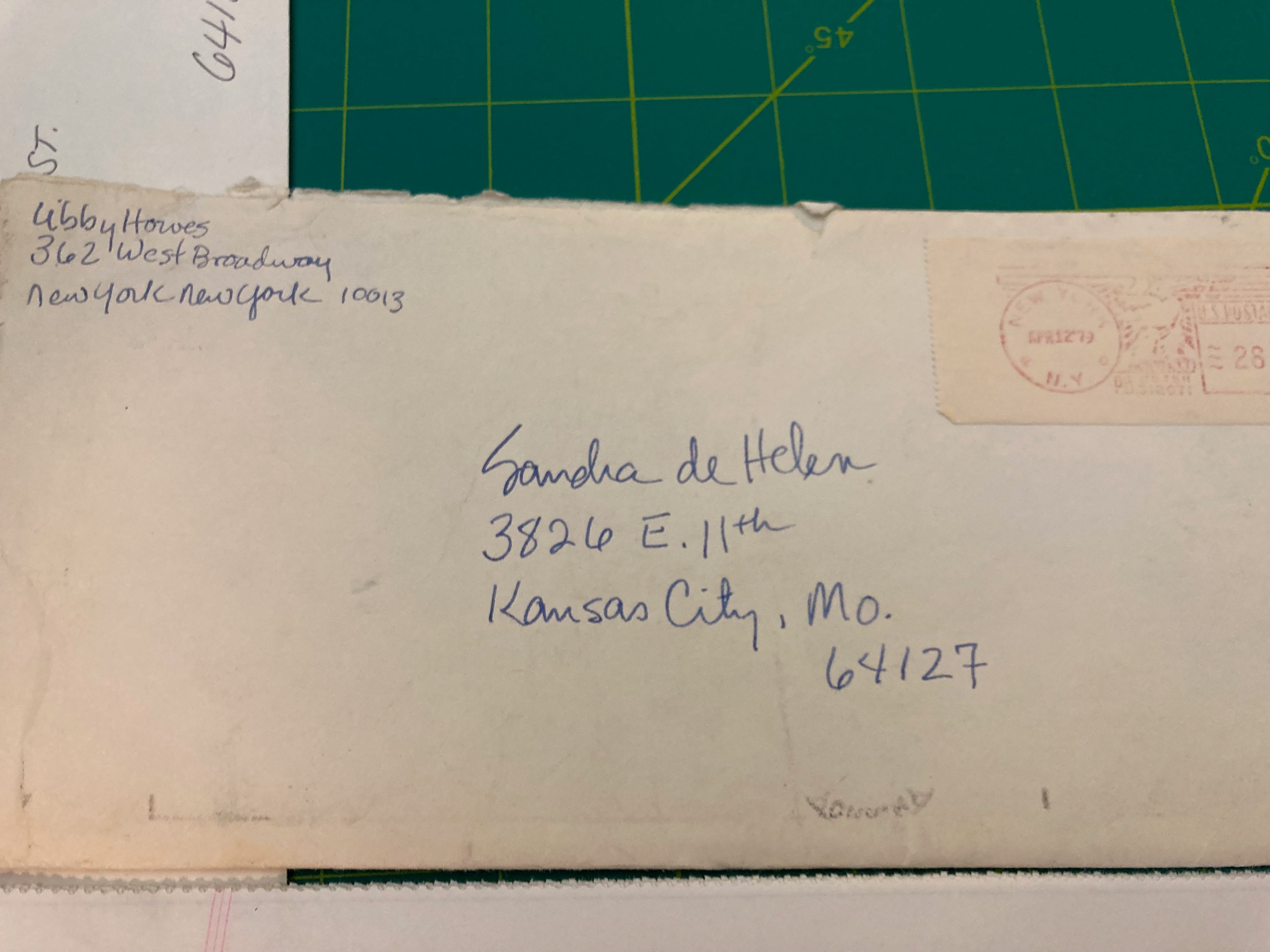
Here’s Libby’s:
12 April 1979
Sandra,
I apologize for not responding sooner. There are several points in your letter of March 26 that I’d like to address. I’ll refer to them as they occur in your letter.
I do not at this time have $15 to spare to send to you for a refund. If I did have this, I’m not sure I would send it. Our company does quite a large business. We serve many people and we sponsor many people but the overhead costs of an organization like this are monstrous and currently we are in debt to our bank for $50,000.
I can understand your being upset by the performance. Many people are. And I’m sorry our organization is not financially stable enough to produce Rumstick in a larger space with more mobile seating. I’m sure more people would leave in the course of a performance, were this true. But as it is we are what you see when you walk in the door. And had you responded to your uncomfortable feelings with the looks of the structure you were to sit on, and had you objected at the beginning to the cramped seating and feeling of imprisonment at that point, it would not have been too difficult or embarrassing to refund you your tickets and sell them to other people in line. By staying you chose to subject yourself to the performance. I admit, had it been an entertaining play with a lift you might have been more tolerant of your condition. But for whatever reasons you came, you saw our work. It’s not common. It’s not easy. And I’ve yet to read any publicity on it that would lead people to believe that it is anything less difficult than it is. Most critics have written about it more darkly than we believe it, but then our lightness and upswing come from working a long time with the material.
There are many ways to show women in work. I’m not sure what generalizations you see in the play offend you. We (and I mean Liz LeCompte and I) worked together for a long time reading from T. S. Eliot’s Cocktail Party (which was later used in Nayatt School). She came to the realization that my voice was not suited for the production. As untrained and youthfull (sic) as it is served to disrupt the strength of the performance. Secondly Bette was dead. She was the only person of all the characters in the play who was not alive during its construction. Since a lot of the material surrounded the memory of other people in reference to her and since we had nothing but the one letter from her addressed to Spald, it seems to fit that I, as a performer, should have nothing to say. I wouldn’t begin to speak for a woman I had never known and expect to come anywhere close. But regardless. The impact of the other things we chose seemed to be much greater and could only be heightened by my silence.
I think in a sense we tried not to illustrate the condition of this woman but to place the tape recordings next to the movements to expand the ideas about this, this woman, or more importantly, this person inside the constellation of this family.
It’s not pleasant. Neither was her condition. Nor do we feel it is possible to create an imaginary set of possibilities for happy outcome. That was not the situation. Nor is it something we want to pursue. Bette set herself in a bind, chose to certain ideas that did not work together in their absolute states and as a result chose to end her life. It’s not noble. Or maybe it is. It depends on how one looks at it. But to even think about this you have to be stirred and this is what our intention was and is: to present the facts as clearly as we can and shade the and give them depth to them with our design and actions.
The intention, or practice, is to try to recognize what is present, to understand the circumstances (in this case) as best they can be remembered and then to go on. As we go on we reflect and in the reflection the circumstances reverberate. This comes out for me in performance. Hearing the tapes over and over I sometimes slip into a phrase or two. Something stands out and another element in the family structure is outlined. I feel that to understand how to move beyond these binds it is necessary to understand the whole weave of the family. True for this story and true for any family, group of people, or couple. The dynamics of people is a very complicated state of being not to be understood by words alone.
Now I come back to contradict myself. We brought together these tapes, tapes from Spalding’s family, and our own responses to this material and tried to build a play that in a way used the tapes as a backdrop or dialog or floor plan. In some way concretely and metaphorically the tapes structured the movement. This isn’t like as it was at 46 Rum Road. It is what is at 33 Wooster as a reverberation of something that happened 12 years ago, discussed and taped three years ago and spun off two years ago. What you saw was a discussion of everything leading to the present.
That’s part of it. Another part is the point of view. The tapes come to you, the script for the most part comes to you through Spald. He asked the questions. He received the letters. He brings it to the theatre as material to work with, material from his point of view. The set design picks up on this. From the audience structure there is no part of the set you cannot see. Everything is naked, angled, or reflected so you can see. Everything is distorted for presentation including the tapes. But the set puts Spalding, obscured but nevertheless between the audience and the performance. He introduces, explains and closes. But it’s all facts. He doesn’t speak for anyone. Not Bette or Rock or Spald. The images speak or you speak in association with the images.
The images provided by us, edited by Liz, a tag game, a dead weight lifting/ghost, a lecture demonstration of a mouth massage, a dance, a tent flip out, rooms are arranged, slide show, Dr. telephone, Gran Gray, Examination, and final letter. How do you see this? Metaphorically I see it as evasion, rejection, victimization, spiritual departure, and finally death -- the final departure.
But that’s my story. I’ve never seen the play. It’s not easy, but I don’t think too much is. The execution of the dance is difficult, but it’s also one of the most elevating things I’ve ever accomplished -- it rivals mountain climbing and it’s more accessible to me. [She’s describing the “dance” in which she bends completely from the waist and rises flinging her hair, back and forth for ten solid minutes.] In the beginning I was extremely sore. We developed this over long rehearsals and each time was excruciating. As my strength has improved and my stamina increased I’ve become much more capable of meeting the choreography in my mind between the important points in the music, my movements, and the tape of Gran Gray. Five women came together to make this (not counting encouragement from friends, Spalding and Ron.) By this I feel strong from the whole process. That alone speaks tremendously for women. I expand from this to think: by victimization I become strong, by being a person under Liz’s direction, I’ve been pressed to prove the extent of my endurance and I can now demonstrate a strenuous condition that few people could or would attempt. As a woman that expands your possibility too. Placing this action in the context of this woman who later goes on to destroy herself is very powerful for me. A determination and discipline in this case lead (sic) to a bind, freedom from which could only come in self-destruction. It’s not something that I’d do. But it is something to learn from. When my mother came to see this she told me my grandmother was in a similar bind caught between the doctrines of a pure and righteous spirituality and the practicality of daily living with a husband and family not as bound as herself to this life. She said that she learned to and tried to consciously fuse the benefits of both worlds. The uplift of both. She was struck by the impact of our work and felt it presented a lot of ideas to toss around.
I’ve gone on quite a bit here. I hope I’ve covered all well enough for you to understand a bit more how this all came about. Rumstick really is just the result of a running discussion.
A couple last points. I think it’s actually healthy for men to speak for women and women to speak for men and them receive corrections in their perception. It’s a way of understanding misconstrued ideas and it’s of the more embarrassing and therefore more difficult things to do. But quite worthwhile. Working under great strain, disadvantage, pressure and criticism can be very rewarding. There are some fantastically fascinating who do that under real life conditions rather than their self-imposed conditions. I respect them. And I’m grateful that this is my choice.
And finally. If this really is bad or evil or whatever, if you feel the need to condemn this work, please feel free to write some more. I really believe (and it always comes to me way after the fact, but I believe) that it is our enemies that keep us on our toes. Whatever form, a challenge is a lesson.
Thank you.
Sincerely,
Libby Howes
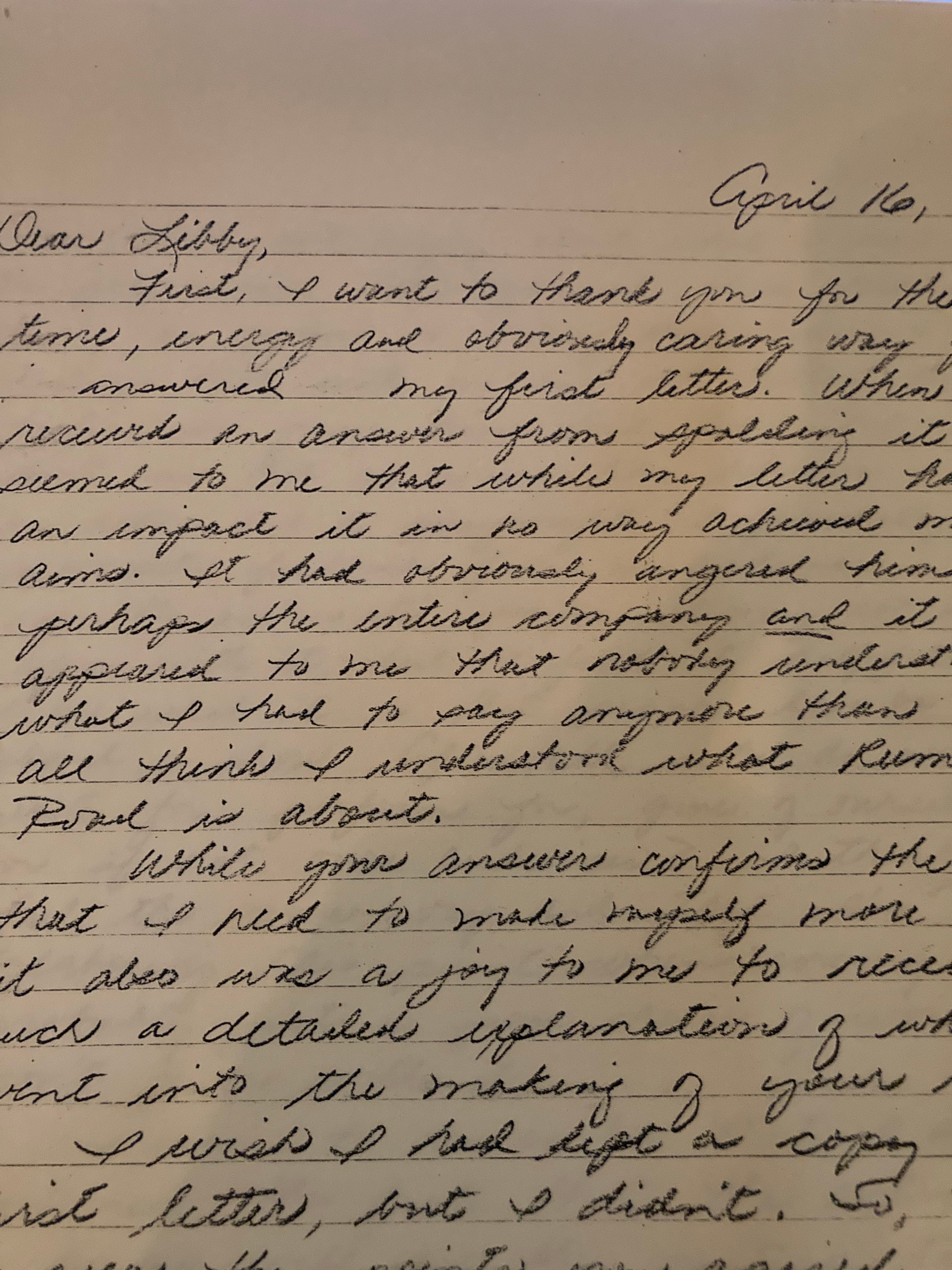
My response: I don’t have it in me to type up ten more hand-written pages. First, I thanked Libby for such a long, detailed letter. I assured her we were not enemies. I reminded her I thought the acting was superb as well as how they used technology so creatively (and more, I went on a bit). I suggested they add to their program a warning about the super loud sound (on purpose in places), and about the seating. I mentioned that At the Foot of the Mountain employed the language (and space for) people to leave when the show becomes too heavy for them.
I told her I didn’t think her youth and untrained voice were reasons to decide she shouldn’t have lines. I pointed out that if Bette couldn’t speak because she was dead then she shouldn’t have been moving either.
I again objected to the “dance.” She herself had admitted it was excruciating. I see no good reason to ask actors to physically hurt themselves on stage. I said I thought her having to do that to prove Bette’s victimization was proof of her own victimization.
I told her I objected to her nude scene because she was the only one naked. (Not to mention being licked and bit all over her chest as she lay on a gurney under bright lights.)
I wished her good luck in her career, again praising her talents.
Every actor in this show is dead now. Spalding Gray jumped off the Staten Island Ferry and died. Ron Vawter died of a heart attack at forty-five. Libby Howes became a theater mystery when she “disappeared” in 1981. She began deteriorating mentally. She stopped her treatment for schizophrenia after a few years. In the 90s she moved to Vermont. Her mother left her a house and a small amount of money which allowed her to live out her life, albeit with no heat or hot water. After the house burned, she moved into a tent in the front yard. She died December 17, 2025.
The link to the article I’ve linked about Libby contains a snippet of her performing the house dance, as well as other photos. You can see that here.
Wow! just wow.
Wow, this is fascinating. I’m struck by how different their responses were to you. Libby was kind and curious. Spalding called you stupid. I want to know more about your take away from their responses.