
On writing...


Photo by Aaron Burden on Unsplash
My writing has slowed to a trickle. But fall is coming, and I feel my blood stirring, my fingers begin to itch to write again. In fact, yesterday I made my first attempt to write a sijo poem. This is a Korean form. Here's more information about the form from the Sejong Cultural Society:
"The sijo (Korean 시조, pronounced SHEE-jo) is a traditional three-line Korean poetic form typically exploring cosmological, metaphysical, or pastoral themes. Organized both technically and thematically by line and syllable count, sijo are expected to be phrasal and lyrical, as they are first and foremost meant to be songs.
Sijo are written in three lines, each averaging 14-16 syllables for a total of 44-46 syllables. Each line is written in four groups of syllables that should be clearly differentiated from the other groups, yet still flow together as a single line. When written in English, sijo may be written in six lines, with each line containing two syllable groupings instead of four. Additionally, as shown in the example below, liberties may be taken (within reason) with the number of syllables per group as long as the total syllable count for the line remains the same. However, it is strongly recommended that the third line consistently begin with a grouping of three syllables.
The first line is usually written in a 3-4-4-4 grouping pattern and states the theme of the poem, where a situation is generally introduced.
The second line is usually written in a 3-4-4-4 pattern (similar to the first) and is an elaboration of the first line's theme or situation (development).
The third line is divided into two sections. The first section, the counter-theme, is grouped as 3-5, while the second part, considered the conclusion of the poem, is written as 4-3. The counter-theme is called the 'twist,' which is usually a surprise in meaning, sound, or other device."
I spent time deciding which category I wanted to try. I read the resources provided. I wrote a first rough draft. The second draft contains the essence of the first, but otherwise is unrecognizable. The third draft gives me a better first line. The fourth draft changes the last two lines. The fifth draft was nearly there. I re-worked the last line to fit the syllabic pattern described above. All the rewrites have created a better poem. I will enter the contest. Whether or not I win, I have created a new poem today.
I also spent time re-reading my unpublished poems. Today every single one seems mundane, and they demand total revision. I need to consider whether I will honor my contract to publish eight to eleven collections. My publisher has produced six collections so far. Fortunately, there is no time limit other than my lifetime. What should I do with my "one wild and precious life"?[1]
The play I'm writing this year is stalled. I've hoped (and applied) for retreat and/or workshop opportunities, but none have materialized. I believe I could finish the first draft easily if I had five to seven days in retreat. As for the novel, I haven't added anything since June 30, but I can finish the first draft by the end of the year if I re-start writing daily. I don't need retreats for novels, but I do have to write every day in order to complete it. Challenges are good for me for that reason. I appreciate Jami Attenberg's #1000DaysofSummer. I could use it more often. Especially in fall, winter, and spring.
Please share what you did this summer, what your fall plans are, what you’re reading, or anything this newsletter has evoked.
When you receive this newsletter, it will be Labor Day. Forty years ago on Labor Day, I fell in love with my friend Pam. We lasted nineteen years as partners, but we've lasted forty years as friends. We are best friends forever indeed. Happy Anniversary, Pam.
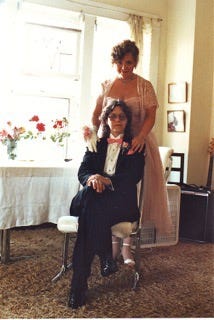
Photo by Anya Blasser, taken June 15, 1984. I’m standing, Pam is seated.
[1] See Mary Oliver's "The Summer Day" poem Summer Day
This looks like a fun form to tackle. Always a challenge to meet format and still make meaning. Often, deeper meaning comes from working at the form.
Thanks for the introduction to sijo. I was hoping we would get to see your poem. I just finished Tom Lake and loved it.